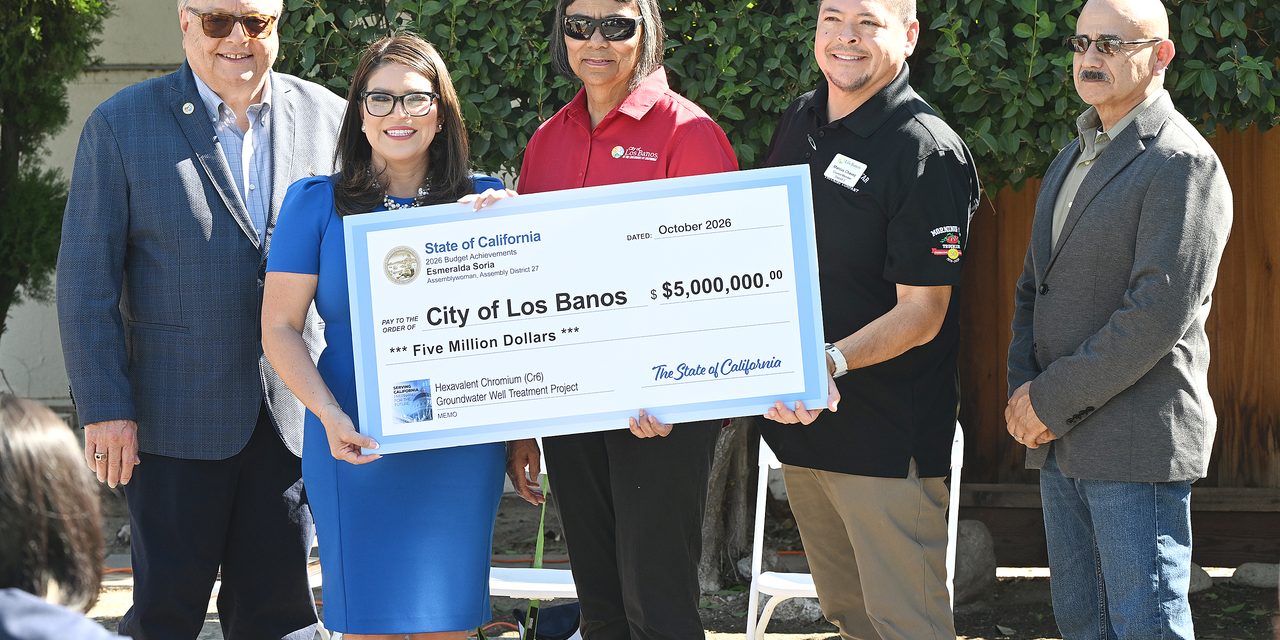
In the shadow of the Los Banos water tower, State Assemblywoman Esmerelda Soria presented an oversized check for $5 million to the City of Los Banos on the morning of Oct. 9.
The funds from Sacramento are to be used for the city’s first pilot filtration to get rid of hexavalent chromium (chromium-6). The ceremony itself lasted roughly 20 minutes before becoming a tour of the city’s waterworks.
The pilot well is Well 9, just east of Toscano Court on Willmott Avenue. According to the report given at the Sept. 2 council meeting, it is expected to cost $4.5 million.
“It’s a crucial first step,” Mayor Michael Amabile said during his speech. Amabile explained that the well will run for two years to pioneer the reduction coagulation filtration (RCF) system chosen by the city.
RCF itself works by blending the chromium-6 with ferrous iron, which turns it into chromium-3, which is then filtered by conventional filters.
The main drawback is that the filters need to be backwashed, and the backwash needs to be disposed of into the sewer system. All other options available to the city were explored and ruled out according to the Sept. 2 report.
Soria said, “When you have state dollars come in, the residents of this community don’t have to see their water bills increase (to pay for RCF).” “Access to safe, reliable, and clean drinking water is something that every single family in every community deserves,” she continued. Soria noted she was wearing a blue dress to represent the water.
“So now let’s make sure that we get those dollars deposited in the bank account so you guys can start all that work that needs to get done,” Soria said to the audience made up mostly of city staff and public works employees.
The entire city council posed with Soria and an oversized check before she was given a tour of the facility. Operations Manager Randy Williamson showed Soria one of the 14 pumps in the city and how each is controlled remotely by the waterworks.
He explained that Los Banos has chromium-6 in all wells, which is unique. Most other cities are able to blend their wells to bring chromium-6 below the new state threshold of 10 parts per billion. “Blending is not an option for us,” Williamson said.
When asked what it took to get these funds from Sacramento, Soria said, “It takes a city being ready, a city being able to ask because they have somewhat of a plan already in place, and then it takes the legislature putting it at the top of the list in terms of priority and asking during the budget negotiations.”
During her speech, Soria explained that the city had a clear list of priorities and needs that made it easier for her to get the funds from the state.
Finance Director Minnie Moreno explained that grants from the state like this are not as simple as depositing a check. She explained that funds have to be spent first, before asking for reimbursement with reports and receipts.
Whether the city will be paid all at once, monthly, or another time frame will be negotiated soon, Moreno said.
Public Works Director William Via, when asked about the potential operating costs of the well, said that he estimates a very rough $150,000 to operate yearly. He emphasized that since RCF has not been used to filter chromium-6 specifically and at this scale, estimates are very rough.
As was previously reported, the point of this pilot test is to get those hard numbers nailed down before expanding to the full system. The estimate to filter all wells in the city was $42 million, but that number may change depending on this well’s performance.