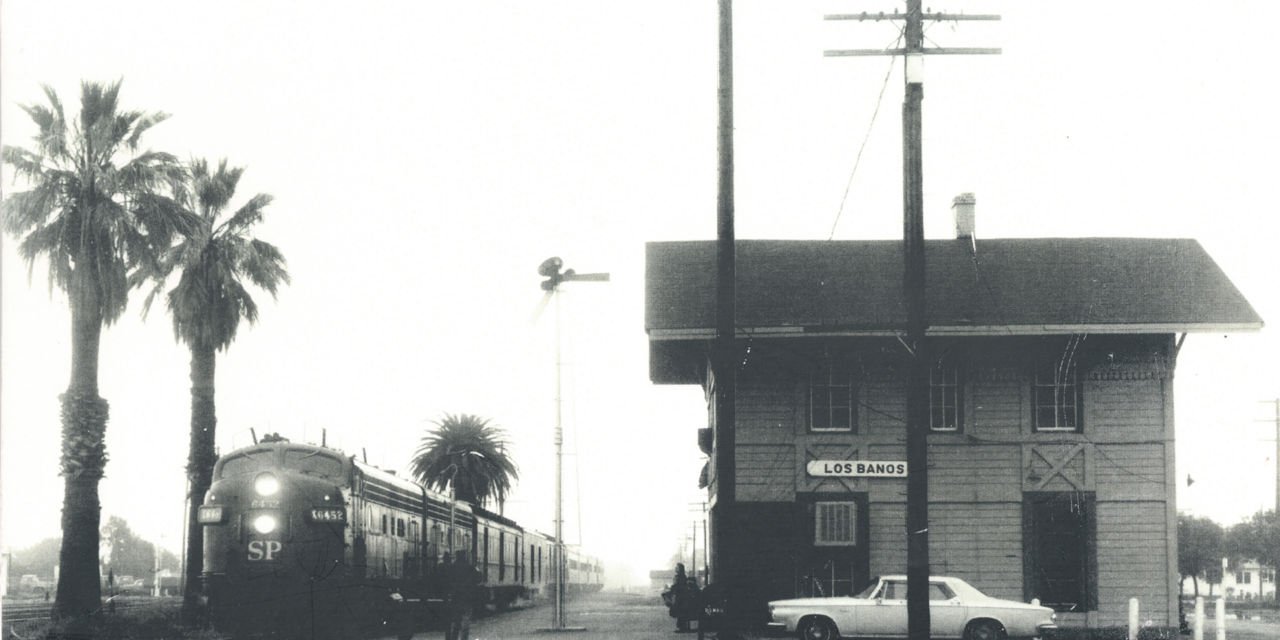
The last Southern Pacific (SP) Railroad passenger train stopped in Los Banos on April 12, 1965. The Owl train, as it was known, stopped at the station that once stood where Henry Miller Plaza is located at 6:32 a.m.
With limited fanfare and a single photographer to capture the moment, it left the station. Despite the limited attention, there was a fight to save the service, occurring almost two years earlier, in 1963.
The struggle began on Aug. 5, 1963, when the head of Southern Pacific public relations in the central district, Carl Olsen, visited Los Banos. On his visit, he broke the news to Los Banos officials. SP wanted to move the Owl line to the east side by Sept. 1.
The Owl of the time travelled overnight from Los Angeles to San Francisco, using the west side of the valley. Northbound trains arrived at 3:43 in the morning, and southbound trains at 12:50 in the morning.
Olsen told Los Banos officials that the Northbound Owl would leave Los Angeles at 10:30 p.m. instead of 7:25 p.m., allowing eastside cities to receive faster mail, and a commuter train would arrive between 6:20 and 9 a.m. to take them to San Francisco by noon.
Olsen implied that the move was at the request of the post office to allow more LA mail to get on the train before it leaves. Olsen further claimed mail could get sped up by “24 hours” in the valley.
Olsen highlighted that throughout July, only 0.7 passengers got on the Owl from Los Banos each day, and 0.8 passengers got off. Calling the usage by the westside, “Extremely light.” Olsen ended by telling LB officials that the shift would help mail throughout the entire valley and would not hurt Los Banos.
The Los Banos Enterprise and City Council did not take his claims at face value. The Enterprise called the San Francisco Post Office and asked to verify Olsen’s claims. Chief of Post Office Transportation and Planning, Francis M. Eagan, denied that the Post Office initiated the move.
Eagan further stated that there were no plans to even use the shifted Owl. The Post Office was waiting for the move to get approved by California’s Public Utility Commission (PUC) before planning. Eagan noted that the east side may not receive much benefit in mail, while the west side would be in for worse mail service
In an editorial, The Enterprise called it a “shell game” and called on SP to put all their cards on the table face-up. The editorial noted that SP’s mail service is subsidized by taxpayers, and taxpayers would foot the bill for the Post Office filling in the gap on the west side.
Effectively Los Banos residents would pay for the east side getting better mail service while theirs worsened. The Enterprise also asked why the timetable for the current route hadn’t been changed instead.
The city council lodged a formal protest with the PUC to force a public hearing. Without a protest, the shift would have been allowed to happen without a public hearing.
The council, as reported by the Enterprise, highlighted that Los Banos was projected to grow to 25,000. Any city of that size needed a rail connection, they argued.
By Aug. 22, the council was the only formal complaint. Meanwhile an unnamed east side city had written in to support the Owl shift. The Enterprise reported that SP had been going to east side communities to drum up support for the plan.
The Enterprise critically noted that without the train, Los Banos would only have a Greyhound bus. Greyhound, “does not appear to be adequate” as it didn’t even connect to Merced; any trips to the county seat would require a trip to Fresno or Modesto.
That same day, the Enterprise editorial criticized public apathy toward the move. “Anything is better than losing by default in the form of public apathy toward a community cause,” the editorial said.
On Aug. 29, the Enterprise reported that the PUC had rejected SP’s timetable, forcing them to file a formal application to remove rail service and have a public hearing on the matter.
The PUC cited the protest of the city council and chamber of commerce as one of the main reasons for the rejection. Additionally, the supervising transportation engineer of the PUC, W. R. Peters, noted “a lot of disadvantages” on the west side. Specifically with the mail service.
The rejection stalled the Sept. 1 shift. On Sept. 19, the SP decided against bringing the matter into a full public hearing. They dropped the plan and replaced it with a timetable change, answering the Enterprise’s earlier question over whether the shift had to happen instead of a timetable change.
Leaving Los Angeles at a later time, the northbound train would arrive in Los Banos at 6:32 a.m. Arriving in San Francisco at 10:10 am.
Not only was the timing better for local use, but the San Francisco Post Office also said it made mail more timely. It even added a connection with the Portland-bound Shasta Daylight in Martinez. The new schedule was adopted on Oct. 27 after PUC approval.
The Enterprise celebrated the victory and called the Owl “A feather in Los Banos’ Cap.” They commended the council and chamber and criticized the general public apathy, “For those few in the community who took the defeatist attitude that you can’t fight the monster railroad, we only hope they have enjoyed their rest and will enjoy the fruits of labor of the civic-minded persons in the community.”
The editorial ended with, “There are always those who say something can’t be done. And there are those who go ahead and do it anyway.”
Unfortunately, while the battle was won, the war was eventually lost. Relegated to a single emphasized article in the April 8, 1965 by the Enterprise was the announcement of the last train. The SP had finally argued with the PUC to let them end the route.
SP claimed they, “[were] losing money on the passenger service.” The PUC cited “apparent public apathy in the matter” for their decision. And thus, not even a rescheduled Owl survived, halting the entire route. Night telegrapher Vera McElrath lost their job with the halting.
That last train left Los Banos at 6:30 in the morning, on April 12, 1965, northbound to Gustine, taking 67 years of passenger service with it.
It marked the end of passenger rail on the west side. When the rail came in 1889, the very town of Old Los Banos and Central Point moved to the railroad-based New Los Banos.
Rail was important; the layout of the new town was oriented to it. Los Banos history is often studied in ‘post-railroad’ and ‘pre-railroad’ chunks at the local Milliken Museum.
Research for this article was done with the Los Banos Enterprise Collection at the Milliken Museum.